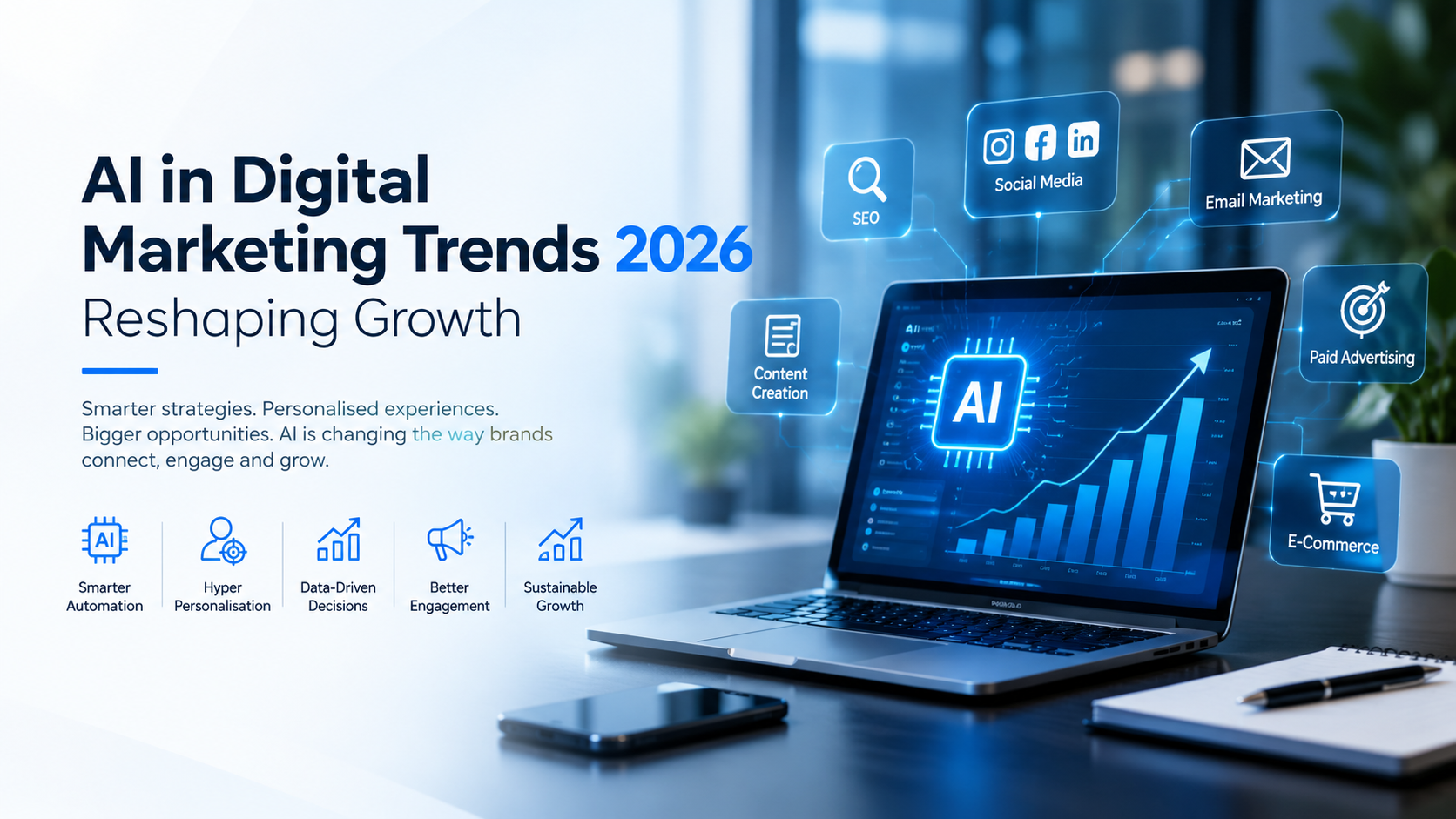
AI in Digital Marketing Trends 2026 Reshaping Growth
Artificial intelligence is changing how businesses attract customers, build brands, manage advertising, and measure results. The most important AI in digital marketing trends in 2026 go beyond content generation. They include autonomous AI agents, predictive personalization, AI-powered search, privacy-first data strategies, and more accountable marketing measurement.
For U.S. businesses, the challenge is no longer simply adopting new marketing technology. It is deciding which innovations can improve customer experience, strengthen brand visibility, and produce measurable business growth.
Research from Kantar, Adobe, Deloitte, and other industry organizations points to a broader transformation. Marketing teams are moving toward connected data, more automated workflows, conversational customer experiences, and stronger expectations around trust and accountability. However, adoption remains uneven, and technology alone does not guarantee better results.
This guide examines 10 emerging marketing trends for 2026, explains how they affect modern marketing strategies, and outlines practical ways businesses can prepare for the future of marketing.
What Are the Key Marketing Trends in 2026?
The leading marketing trends in 2026 reflect a shift toward intelligent automation, relevant customer experiences, distributed brand discovery, and measurable performance. The biggest opportunities are not limited to artificial intelligence. They also involve privacy, creative strategy, community engagement, and the ability to connect marketing activity with revenue.
The following trends deserve particular attention:
- AI-powered marketing workflows and autonomous agents
- Predictive personalization and real-time customer engagement
- Generative Engine Optimization (GEO) and AI-powered search
- First-party data and privacy-first marketing
- AI-assisted content creation with human oversight
- Marketing automation and omnichannel orchestration
- Conversational commerce and AI shopping assistants
- Short-form video, creators, and niche communities
- Brand trust, authenticity, and creative differentiation
- Advanced marketing measurement and revenue attribution
These are not equally mature. Some are established practices gaining wider adoption, while others remain emerging opportunities that businesses should test before making major investments.
1. AI Is Becoming the Operating Layer of Digital Marketing
One of the most significant digital marketing trends is the movement from isolated AI experiments to integrated marketing workflows.
Businesses already use generative AI to research audiences, develop campaign concepts, draft content, analyze customer feedback, and produce creative variations. The next step is connecting these activities so that teams can move from research to execution with less manual work.
Deloitte’s 2026 marketing research highlights the growing role of AI in marketing operations and the need to combine machine intelligence with human creativity. Adobe’s 2026 Digital Trends research also examines the move toward agentic AI, which can take actions across connected workflows.
How businesses can use AI
Marketing teams can apply AI to:
- Analyze customer feedback and identify recurring concerns.
- Generate and test alternative advertising messages.
- Summarize campaign performance and identify unusual changes.
- Assist with email segmentation and content personalization.
- Automate repetitive reporting and campaign preparation.
For example, a U.S. e-commerce company could use AI to identify common questions in customer support conversations, develop content addressing those questions, and suggest email campaigns based on relevant customer behavior.
The human team should still verify the findings, approve customer-facing messages, and protect sensitive information.
Business takeaway: Start with one repetitive workflow, establish a baseline for time and quality, and expand only when the results justify the investment.
2. Predictive Personalization Is Moving Beyond Basic Segmentation
Personalization remains one of the most important consumer marketing trends, but expectations are changing. Adding a customer’s first name to an email is no longer the full extent of personalized marketing.
Modern systems can combine consented customer data, purchase history, browsing behavior, and engagement signals to help determine which message, product recommendation, or offer may be relevant to an individual.
In its 2026 AI marketing trends coverage, Emarsys highlights the gap between the capabilities of personalization technology and the experiences customers actually receive. The underlying lesson is that sophisticated tools cannot compensate for poor data or irrelevant messaging.
What predictive personalization looks like
A retailer might identify customers who regularly purchase a particular product category and send relevant replenishment reminders. A software company could deliver educational content based on the features a prospective customer has explored.
The goal is to make interactions more useful, not simply more frequent.
Businesses should measure conversion rate, incremental revenue, customer retention, unsubscribe rates, and customer satisfaction. They should also respect consent and applicable privacy requirements.
Business takeaway: Use behavioral data to improve relevance, but avoid excessive tracking or personalization that makes customers feel watched rather than understood.
3. GEO and AI-Powered Search Are Expanding Brand Discovery
Search is no longer confined to traditional search-engine results pages. Customers may discover brands through Google, YouTube, social platforms, online communities, and AI-powered tools such as ChatGPT and Gemini.
This shift has increased interest in Generative Engine Optimization (GEO), Answer Engine Optimization (AEO), and broader AI SEO strategies.
The practical objective is to make information useful, accessible, accurate, and easy to understand across different discovery experiences.
How to improve visibility in AI-powered search
Businesses should focus on:
- Answering real customer questions directly.
- Publishing original insights rather than repeating existing articles.
- Using descriptive headings and clear explanations.
- Supporting factual claims with credible evidence.
- Maintaining accurate product, service, and company information.
- Building relevant internal links and making important pages accessible to search crawlers.
For example, a cybersecurity company could publish a detailed guide comparing security approaches for small businesses, explaining costs, limitations, implementation requirements, and common mistakes.
That page provides more value than an article that repeatedly inserts phrases such as “best cybersecurity solution.”
There is no guaranteed method for securing an AI citation. Google’s official guidance confirms that established SEO fundamentals remain relevant to AI Overviews and AI Mode, without requiring a separate set of special AI-search optimizations.
Business takeaway: Build genuinely useful resources that deserve to be discovered, cited, and recommended. Do not rely on keyword repetition or unsupported claims about GEO ranking factors.
4. First-Party Data Is Becoming a Strategic Marketing Asset
Privacy, data quality, and customer trust are central to current marketing trends. Businesses increasingly need reliable ways to understand their audiences without depending entirely on third-party tracking.
First-party data includes information customers provide directly or that a business collects through its own legitimate interactions, such as purchases, account activity, subscriptions, and consented preferences.
Why first-party data matters
Reliable first-party data can support audience segmentation, customer retention, personalization, and campaign measurement. It also helps organizations understand how customers interact with their own channels.
However, collecting more information is not automatically better. Businesses need a clear purpose for collecting data, suitable security controls, transparent disclosures, and compliance with applicable privacy laws.
A practical approach is to improve the quality of existing customer records before investing in additional tools. Remove duplicate entries, standardize important fields, establish consent preferences, and document how data is used.
Business takeaway: Treat customer data as a responsibility and a business asset. Better data governance can improve both marketing decisions and customer confidence.
5. Human-Guided AI Content Is More Valuable Than Content Volume
Generative AI has made it easier to produce blog posts, landing pages, email campaigns, product descriptions, and advertising concepts. Yet the ability to generate content quickly does not mean every piece deserves to be published.
One of the most important content marketing trends is the need to combine AI-assisted production with human expertise, editorial judgment, and original value.
What effective AI-assisted content requires
A strong workflow includes:
- Researching the audience and identifying a real information need.
- Using AI to organize research, explore ideas, or develop an initial structure.
- Adding expert insight, original examples, and relevant evidence.
- Checking facts, terminology, quotations, and statistics.
- Editing for the brand’s voice, clarity, and usefulness.
- Reviewing performance and updating content when information changes.
For example, an AI-assisted article about marketing analytics should not simply repeat popular definitions. It should explain which metrics matter for different business models, how to interpret results, and where measurement can be misleading.
Google’s spam policies warn against scaled content created primarily to manipulate rankings without providing meaningful value. The issue is not whether AI was used; it is whether the published content is original, useful, and trustworthy.
Business takeaway: Measure content by its usefulness and contribution to business goals, not by the number of articles produced each month.
6. Marketing Automation Is Evolving Into Omnichannel Orchestration
Traditional marketing automation relies on predefined triggers, schedules, and workflows. More advanced systems can use customer data and AI to recommend actions, coordinate channels, and help teams adapt campaigns as conditions change.
Klaviyo’s 2026 marketing automation research identifies AI copilots, autonomous orchestration, privacy, and unified customer data as important areas of development.
What this means for marketing teams
A connected customer journey might begin with an educational video, continue with a website visit, and lead to an email subscription. Later interactions can inform which message the customer receives next.
The goal is not to contact a customer on every available channel. It is to coordinate communications so that each interaction has a clear purpose.
Businesses should define frequency limits, customer preferences, suppression rules, and escalation paths before automating campaigns at scale.
Useful performance measures include conversion rate, customer retention, revenue per recipient, engagement, and unsubscribe rate.
Business takeaway: Automate repetitive decisions while keeping human oversight over sensitive communications, customer complaints, and high-impact decisions.
7. Conversational Commerce and AI Shopping Agents Are Emerging
AI-powered assistants are beginning to influence how customers research products, compare options, and complete purchase-related tasks. This creates new possibilities for conversational commerce and agent-assisted shopping.
Kantar’s Marketing Trends 2026 research discusses the emergence of purchasing agents and the importance of preparing brands for a world where digital systems may increasingly assist consumer decisions.
This is an emerging trend, not evidence that all consumers have shifted to agent-led purchasing.
How brands can prepare
Businesses can strengthen their foundations by maintaining:
- Accurate product names and descriptions.
- Current pricing, availability, and shipping information.
- Clear return policies and product specifications.
- Accessible customer support and purchase information.
- Consistent details across relevant sales channels.
Retailers should also evaluate how their products are represented in AI-generated recommendations and monitor referral traffic where reliable reporting is available.
Business takeaway: Make product information accurate, complete, and easy to verify before investing heavily in experimental conversational shopping features.
8. Short-Form Video, Creators, and Communities Remain Important
Social media and creator partnerships continue to shape brand discovery. Short-form video can explain a product quickly, demonstrate how something works, and introduce a business through a recognizable human voice.
At the same time, niche communities can help businesses develop deeper relationships with audiences who share specific interests or needs.
These are continuing trends in advertising and brand marketing rather than entirely new inventions of 2026.
How to apply these trends
A business could turn a customer question into a short educational video, collaborate with a relevant industry creator, or publish a practical tutorial that answers a recurring audience problem.
The strongest partnerships depend on audience relevance, credibility, creative fit, and transparent sponsorship disclosures—not follower count alone.
Measure outcomes according to the campaign’s objective. Reach and views may matter for awareness, while qualified visits, leads, sales, and repeat purchases may matter more for performance campaigns.
Business takeaway: Prioritize credible voices and useful content over chasing every trending format.
9. Brand Trust and Creative Differentiation Matter More
As AI makes content and creative production easier, audiences may encounter more similar messages across competing brands. That makes recognizable positioning, credible claims, and consistent customer experiences increasingly important.
Deloitte’s 2026 marketing analysis highlights the growing value of trust and authenticity amid changes in consumer behavior and digital content.
How businesses can build trust
Brands can strengthen credibility by explaining what makes their products different, using accurate testimonials, publishing clear policies, and ensuring that marketing promises match the customer experience.
AI-generated imagery, synthetic endorsements, and automated messages require particular care. Businesses should avoid misleading representations and disclose material relationships where required.
Creative marketing trends should serve the brand’s strategy rather than replace it. A viral format may generate attention without attracting qualified customers.
Business takeaway: Use technology to express a distinctive brand identity, not to produce more interchangeable marketing.
10. Marketing Measurement Is Shifting Toward Business Outcomes
Marketing teams face increasing pressure to show how campaigns contribute to revenue and sustainable growth. That makes measurement one of the most important marketing technology trends.
Traditional metrics such as impressions, clicks, and engagement remain useful, but they do not independently establish business impact.
Metrics worth monitoring
| Business objective | Useful measures |
|---|---|
| Brand awareness | Reach, qualified branded searches, brand-lift studies |
| Lead generation | Qualified leads, conversion rate, cost per qualified lead |
| E-commerce growth | Conversion rate, contribution margin, repeat purchase rate |
| Customer retention | Repeat purchase rate, churn, customer lifetime value |
| Content performance | Organic clicks, assisted conversions, qualified engagement |
| Marketing efficiency | Cost per acquisition, incremental return, time saved |
Attribution models can help explain which channels receive credit for conversions, but they do not always establish causation. Where feasible, experiments, holdout groups, and incrementality tests can provide stronger evidence of whether a campaign caused additional business results.
The best measurement framework connects marketing activity with the organization’s actual objectives.
Business takeaway: Choose a small set of meaningful metrics, establish a baseline, and test whether new technology improves outcomes rather than assuming it does.
What Do These Marketing Trends Mean for the Future?
The future of marketing will likely involve more automation, more complex discovery journeys, and higher expectations for relevant customer experiences. However, successful businesses will still need sound strategy, credible information, creative judgment, and reliable measurement.
The most useful response to emerging marketing trends is not to adopt every new platform. It is to identify where customer behavior is changing, determine which capabilities address a real business problem, and test those capabilities against measurable objectives.
Smaller companies can begin with a focused AI workflow, stronger customer data, clearer content, and more disciplined reporting. Larger organizations may need to prioritize data integration, governance, cross-functional coordination, and accountability for AI-assisted decisions.
The strongest marketing strategies will combine technology with the fundamentals that remain durable: understanding customers, communicating a clear value proposition, earning trust, and delivering a product or service that meets expectations.
FAQs
How is AI changing digital marketing in 2026?
AI is helping marketing teams research audiences, create and test content, personalize customer experiences, analyze campaign performance, and automate repetitive workflows. More advanced applications include AI agents and connected marketing systems. Results depend on data quality, implementation, human oversight, and the business objective.
What are the top 10 digital marketing trends for 2026?
The leading trends covered in this guide are AI-powered workflows, predictive personalization, AI-powered search and GEO, first-party data, human-guided AI content, omnichannel automation, conversational commerce, short-form video and communities, brand trust, and outcome-focused measurement.
Why does AI matter in digital marketing today?
AI can help businesses process information, develop campaign variations, identify patterns, and perform repetitive tasks at scale. Its value comes from applying those capabilities to genuine customer and business needs, not from using AI simply because it is available.
Will AI replace digital marketers?
AI is likely to automate some repetitive marketing tasks and change how many roles operate. It does not eliminate the need for strategic judgment, creative direction, ethical decisions, customer understanding, and accountability. Professionals who can combine technology with these capabilities are better positioned to adapt.
How can small businesses keep up with marketing trends?
Small businesses can follow reputable industry research, monitor customer feedback, review their campaign data, and test one change at a time. They should prioritise opportunities that fit their budget and audience rather than adopting every new tool or trend.
What is the difference between SEO, AEO, and GEO?
SEO focuses on helping content become discoverable in search engines. AEO emphasizes clear answers to specific questions across answer-oriented experiences. GEO focuses on improving the usefulness and visibility of information in generative AI experiences. These approaches overlap, and none guarantees inclusion in an AI-generated answer.
How can companies measure the success of new marketing trends?
Companies should define the intended outcome before implementation. Depending on the initiative, they may measure qualified leads, conversion rates, incremental revenue, customer retention, acquisition costs, or time saved. Experiments and consistent reporting help distinguish genuine improvement from correlation.
conclusion
The AI in digital marketing trends of 2026 point toward a more connected, automated, and data-informed industry. Yet technology is only part of the equation.
Businesses that combine useful content, relevant personalisation, responsible data practices, credible brand communication, and meaningful measurement can make better decisions about where to invest.
The objective is not to follow every new marketing trend. It is to identify the changes that matter to your customers, test them responsibly, and turn the results into a sustainable competitive advantage.